
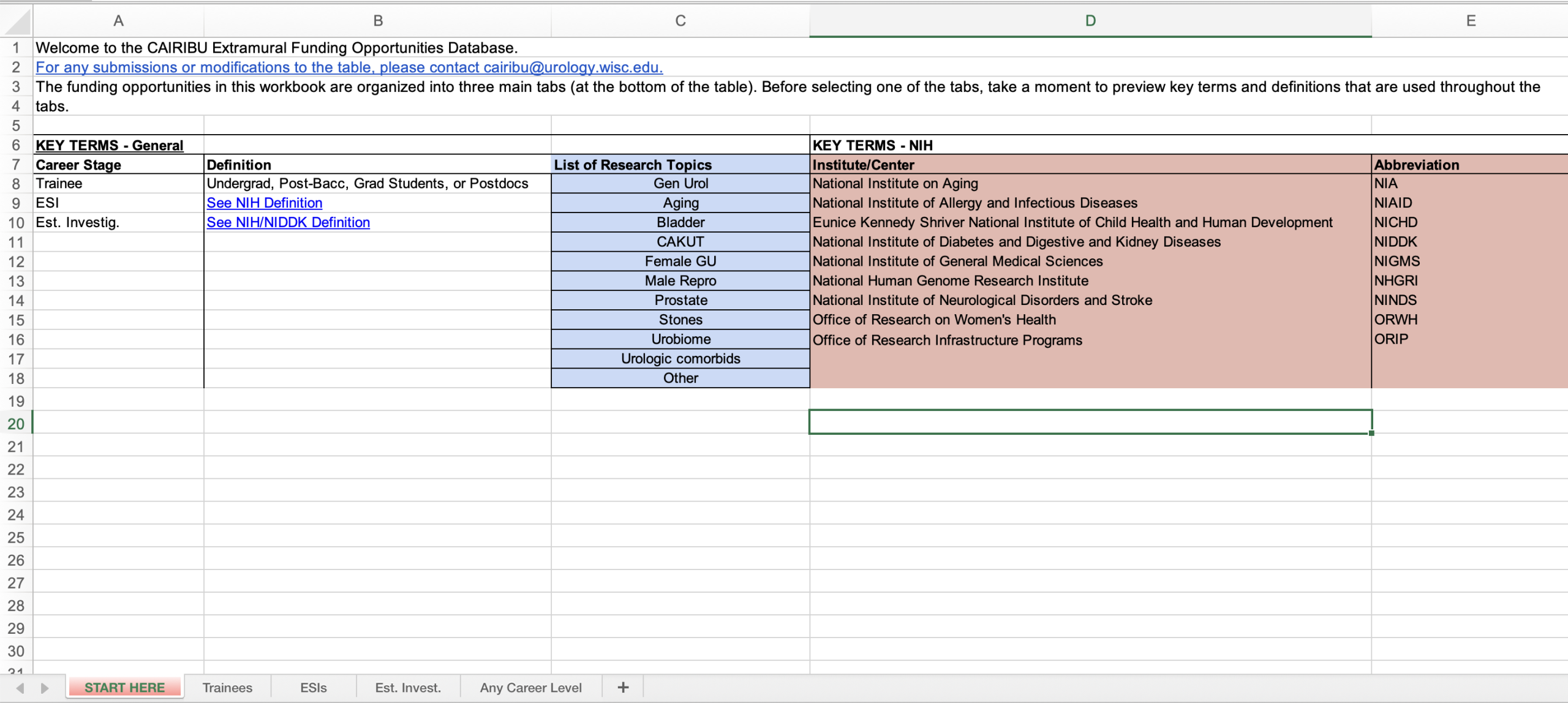
The CAIRIBU U24 Interactions Core curates and maintains a collection of funding opportunities for CAIRIBU-affiliated investigators. This includes grants from the National Institutes of Health, institution-specific funding aimed at enhancing stakeholder engagement in research, and various funding sources that support non-malignant urologic research.
See below for the latest NIH and other extramural research funding opportunities
[Updated Sep 2025]: NIH Simplified Review Framework
NIH has implemented a simplified framework for the peer review of the majority of competing research project grant applications, beginning with submissions with due dates of January 25, 2025. Under the simplified review framework, the five regulatory criteria (Significance, Investigators, Innovation, Approach, Environment) are reorganized into 3 factors: (1) Importance of the Research (Significance, Innovation), (2) Rigor and Feasibility (Approach), and (3) Expertise and Resources.
December 1, 2025[IMPORTANT NOTICE] New NIH Policy: Annual Application Cap and AI Use
The NIH issued a new policy (NOT-OD-25-132) that will impact proposal submissions beginning September 25, 2025. Key points: (1) Application Cap: Each PI (or MPI team) will be limited to six applications per calendar year across all NIH deadlines, (2) AI Use: NIH emphasizes that applications must reflect original scientific thought. Use of generative AI tools is permitted for drafting support, but final content must be authored by the PI/team.
December 1, 2025
NIDDK Funding Announcements
Institutional Network Award for Promoting Kidney, Urologic, and Hematologic Research Training (U2C – Clinical Trial Not Allowed)
Supports programs to recruit, train, and retain the next generation of researchers and provide them with the coordinated support, resources, and networks they need to succeed and lead. Institutions should submit a single, unified U2C-TL1 application. Representation across all kidney, urologic, and hematologic disciplines not expected or required. May include multiple departments within and across institutions. Each U2C-TL1 award will actively participate in the Kidney, Urology and Hematology Research-Training Network (KUHR-TN), a nationwide coalition of individual U2C-TL1 awards. [Posted 12/10/2025. Expires 5/26/2028.]
Diabetes Research Centers (P30 Clinical Trial Optional)
To bring together basic and clinical investigators to enhance communication, multidisciplinary collaboration, and effectiveness of ongoing research in Diabetes Research Centers topic areas. Shared access to specialized technical resources (research cores) and support for a Pilot and Feasibility Program (P&F) will provide the capability for accomplishments greater than those that would be possible by individual research project grant support alone. [Posted 12/5/2025. Expires 1/28/2027.]
Stephen I. Katz Early Stage Investigator Research Project Grant (R01 Clinical Trial Not Allowed)
Providers a new pathway for ESIs to propose research projects in a new direction for which preliminary data do not exist. Open to a broad range of scientific research relevant to the mission of the participating NIH Institutes and Centers, including NIDDK, NIA, NICHD, & NIAD. [Posted 8/25/2025. Expires 8/26/2028.]
Mentored Patient-Oriented Research Career Development Award (Parent K23 – Independent Clinical Trial Not Allowed)
Supports the career development of individuals with a clinical doctoral degree who have made a commitment to focus their research endeavors on patient-oriented research. [Posted 4/9/2024. Expires 5/8/2027]
Mentored Quantitative Research Development Award (Parent K25 Independent Clinical Trial Not Allowed)
To attract to NIH-relevant research from investigators whose quantitative science and engineering research has thus far not been focused primarily on questions of health and disease. [Posted 4/23/2024. Expires 5/8/2027]
- More NIDDK Funding posts
Funding Announcements From Other NIH Institutes
BRAIN Initiative: Research Resource Grants for Technology Integration and Dissemination (U24 Clinical Trial Not Allowed)
For efforts to disseminate resources for integration into neuroscience research practice. The resource(s) should be relevant to the goals of the BRAIN Initiative, shared broadly to the neuroscience community and address compelling needs of neuroscience researchers that are otherwise unavailable or impractical in their current form. May be relevant to research pertaining to the spinal cord and brain-bladder connections. [Posted 2/9/2026. Expires 10/7/2028.]
Advancing Bioinformatics, Translational Bioinformatics and Computational Biology Research (R01 Clinical Trial Optional)
For projects driving groundbreaking innovation and advanced development in bioinformatics, translational bioinformatics, and computational biology. Supports creation and implementation of cutting-edge methods, tools, and approaches that can transform the landscape of biomedical data science given the growing need to leverage transformative technologies — such as artificial intelligence (AI), machine learning, and large-scale computational platforms — to extract actionable knowledge from vast, diverse, and complex biological datasets. [Posted 2/11/2026. Expires 3/6/2029.]
Research Grants in Clinical Informatics (R01 Clinical Trial Optional)
Supports research on the design, implementation, and evaluation of clinical informatics tools and methods that enable data-driven discovery, promote evidence-based decision-making, and support personalized and precision health care. Ideal projects transform raw and heterogeneous health data into actionable knowledge, to develop innovative tools, and to implement practical applications with broad clinical applications. [Posted 2/11/2026. Expires 3/6/2029.]
Resource-Related Research Projects for Development of Models and Related Materials for Studying Human Health and Diseases (R24 Clinical Trials Not Allowed)
Projects (1) developing, characterizing, or improving research models of human health and diseases, (2) developing biology based new approach methodologies (NAMs) applicable to human health and diseases, or (3) improving access to information about or generated from the use of models of human disease. Must: (1) broadly apply to >1 NIH Institutes or Centers' scientific interests, (2) evaluate diseases and processes that impact multiple organ systems, (3) describe the need for and potential impact of the proposed resources. [Posted 12/5/2025. Expires 9/29/2028.]
Animal and Biological Material Resource Centers (P40 Clinical Trial Not Allowed)
Supports continuation of existing or development of new special colonies of laboratory animals and associated services and other resources such as informatics tools, reagents, cultures, and genetic stocks serving the biomedical research community. Proposed projects should: (1) provide research resources facilitating optimization and enhancement of scientific rigor, transparency, and experimental reproducibility, (2) broadly apply to multiple NIH Institutes or Centers. [Posted 12/4/2025. Expires 1/10/2029.]
- More Other NIH Funding posts
AUA Funding Announcements
Science and Quality Fellow Program
The Science and Quality Fellow Program advances the fields of guidelines, quality, and data. It also helps residents and fellows develop insight into how the AUA develops and promotes the advancement of evidence-based science.
- More AUA Funding posts
Funding Announcements From Societies and Other Sources
NSF Postdoctoral Research Fellowships in Biology (PRFB)
Accepting proposals from recent doctoral degree recipients focused on the Intersection of Artificial Intelligence and Biological Sciences to Strengthen and Safeguard Biotechnology Innovations. Candidates with AI and/or biology experience will develop deep expertise in both areas. Fellows expected to become field leaders who use AI capabilities to extrapolate from biological data to technological advances. Proposers are encouraged to consider how to leverage the nation's diversity of existing biological data, and biological infrastructure to accelerate discovery, innovation and biotechnology for the public good. [Posted 2/5/2026. Deadlines: 9/29/2026, 4th Tuesday in Sept, annually thereafter.]
Hamilton Research Support Grant
For qualifying research labs impacted by recent funding cuts. May apply for a single instrument or a bundle of benchtop instruments from the Hamilton Company, with a total combined value of up to $150,000. Documentation detailing the impact of these instruments on your research funding required. Submissions accepted quarterly. [Deadlines: 3/31/26, 6/30/26.]
ARPA-H Mission Office Innovative Solution Openings
Proposals that advance care models, novel business solutions, and substantial technical innovation. Proposals relate to clinical tool, technology, and platform development, prevention detection, prophylactic treatments, population-level approaches, and improving robustness of healthcare systems. [Expires: 3/20/2029.]
Defense Health Agency Unsolicited Proposals
Individuals or organizations may submit unsolicited proposals that include an abstract, statement of work, key personnel, and the type of support needed from the agency. [Rolling deadline.]
Defense Health Agency Extramural Medical Research Funding
Projects benefitting and informing both military and civilian medical practice and knowledge, including basic research, applied research, advanced technology development, and, under certain conditions, may include activities involving advanced component development and prototypes. Relevant research areas include female and male reproductive health. Submission of a pre-proposal/pre-application required; must be submitted through the electronic Biomedical Research Application Portal. [Full proposals due: 9/30/27.]
- More Other Funding posts
Aging-Related Funding Announcements
Funding to Present Aging Research Findings at Conference
Up to $2,000 to cover travel expenses and meeting-related fees to encourage investigators in the field of aging research to present findings at an annual scientific or medical specialty association meeting where aging-related research is not the primary focus. [Applications accepted on a rolling basis.]
Biology of Aging Rapid Data Award
Up to $10,000 supporting efficient acquisition of data for grant applications or publications relevant to the biology of aging and mechanisms linking aging to aging-associated diseases. Open to all investigators, esp those outside the University of Rochester. All projects should utilize Upstate NY NSC Research Core services. Collaboration with other Nathan Shock Centers strongly encouraged. [Applications accepted on a rolling basis and reviewed monthly.]
Fund for Conferences on Understanding Human Lifespan and Processes of Aging
Up to $10,000 to support scientific meetings, conferences, and workshops relevant to the mission of the Hevolution Foundation. Larger support may be considered. Open to non-profit organizations, public and private universities, colleges, laboratories and government agencies in North America, the UK, and EU countries hosting meetings in said regions. [Annual applications deadlines: January 31, April 30, July 31, October 31.]
NIH Exploratory/Developmental Research Project Grant (Parent R21 Basic Experimental Studies with Humans Required)
Supports the early and conceptual stages of exploratory and developmental research projects that may involve considerable risk but may lead to a breakthrough in a particular area or to the development of novel techniques, agents, methodologies, models, or applications that could have a major impact on a field of biomedical, behavioral, or clinical research. [Posted 12/18/2024. Expires 01/08/2028.]
Stephen I. Katz Early Stage Investigator Research Project Grant (R01 Basic Experimental Studies with Human Required)
Provides a new pathway for ESIs who wish to propose research projects in a new direction for which preliminary data do not exist. Open to a broad range of scientific research relevant to the mission of the participating NIH Institutes and Centers (ICs), notably NIA, NICHD, ORWH. [Posted August 25, 2025. Expires August 26, 2028.]
- More Aging-Related Funding Posts
Travel Awards
No posts currently available to show
Institution-Specific CTSA Stakeholder Engagement Funding Announcements
University of Wisconsin-Madison – Institute for Clinical & Translational Research (ICTR) Funding
The ICTR Learning Health System (LHS) Demonstration Program invites clinical faculty to work on projects that are a priority for the UW Health system and can be addressed using an informatics, data-driven workflow with a focus on healthcare outcomes. [LOI due 2/20/26, Application deadline: 6/8/26.]
- More Institution-Specific CTSA Stakeholder Engagement Funding posts
NIH Data Book – The NIH Data Book (NDB) provides basic summary statistics on extramural grants and contract awards, grant applications, the organizations that NIH supports, the trainees and fellows supported through NIH programs, and the national biomedical workforce.
Go HERE for a 1-page CAIRIBU Interactions Core document that spells out the requirements and provides links to resources. These include a site for creating your own DMS plan and various dkNET resources (e.g., archived webinars and recordings about creating and sustaining a FAIR biomedical data ecosystem and FAIR data principles short tutorial video for preparing a DMS plan and finding data repositories; curated list of data repositories for publishing your data). A couple of sample plans are linked below: